
Views: 106 Author: Site Editor Publish Time: 2025-12-09 Origin: Site


Content Menu
● Defining Complex Geometries in Practice
● Available CNC Machining Processes and Their Practical Limits
● Material Behavior under Complex Machining Conditions
● A Practical Process-Selection Framework
● Optimization Techniques That Actually Work
● Q&A
Complex geometries have become routine in modern manufacturing. Turbine blades with ruled surfaces, lightweight lattice structures for aerospace, injection mold cores with conformal cooling channels, and patient-specific titanium implants all share one thing: none of them can be produced economically or accurately without careful alignment of workpiece material, machine capability, and cutting strategy. The days of simply throwing a part on a 3-axis mill and hoping for the best are long gone. Today, engineers must treat process selection as a deliberate matching exercise—geometry demands, material response, tool reach, and cycle-time targets all have to line up.
This article walks through that matching process in practical terms. It draws directly from shop-floor experience and from peer-reviewed work published between 2001 and 2025. The goal is straightforward: give manufacturing engineers a clear, repeatable method for choosing the right CNC approach the first time, without expensive trial-and-error runs.
A geometry becomes “complex” when standard 3-axis toolpaths cannot reach all features in a single setup or when conventional linear moves produce unacceptable scallop height, chatter, or subsurface damage. Common triggers include:
Deep pockets with length-to-diameter ratios above 8:1
Undercuts or negative draft angles
Thin walls or webs below 1.5 mm
Continuously varying curvature (NURBS surfaces)
Internal cooling channels that turn multiple corners
Compound angles on holes or bosses
For example, a typical centrifugal impeller has blades that twist 60–80° from hub to shroud while tapering from 8 mm at the root to 1 mm at the tip. A bone plate for craniofacial reconstruction follows the exact curvature of a CT scan, with thickness varying from 0.8 mm to 3 mm in a single contour. These parts force the engineer to think about tool orientation at every point on the surface.
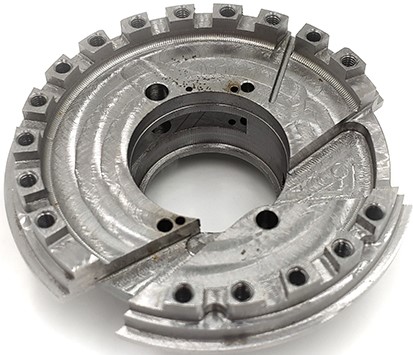
Still the workhorse for 70 % of prismatic parts. Excellent for pockets, slots, and drilled patterns. When indexed (3+2), the rotary table positions the part, then locks for rigid 3-axis cuts. Cycle times are reasonable, but every new orientation requires a separate setup and increases fixturing cost and introduces stacking tolerance errors.
Ideal for parts with rotational symmetry—cam lobes, helical gears, extruder screws. The A-axis rotates while X, Y, Z move, allowing wrapped toolpaths. Undercuts are still limited unless the part is very small.
The tool tip and tool axis vector are controlled independently in real time. This is the only practical way to machine ruled surfaces, deep blade roots, and leading/trailing edges without secondary benching or EDM. Two main configurations exist: table-table (trunnion) and head-head (nutating). Each has trade-offs in work envelope and dynamic stiffness.
Live tooling and Y/B-axis on a lathe handle parts that are primarily turned but need milled flats, cross-holes, or eccentric features. Common in hydraulic manifolds and medical screws.
Wire EDM for hardened materials with tight internal corners, high-speed micro-milling for features below 0.3 mm, and hybrid additive-CNC for near-net preforms.
Material response changes dramatically once the tool is no longer cutting flat faces.
Aluminum 7075 – High thermal conductivity allows aggressive feeds (up to 0.25 mm/tooth at 15 000 rpm), but low modulus means thin walls spring away from the tool unless stepovers are kept below 5 % of diameter.
Ti-6Al-4V – Low thermal conductivity and high chemical affinity with cobalt binders cause rapid flank wear. Cutting speeds rarely exceed 60 m/min in finishing, and climb milling is mandatory to avoid re-cutting chips.
Inconel 718 – Work-hardens instantly if engagement varies. Trochoidal or constant-engagement toolpaths are almost always required.
Hardened tool steels (52–62 HRC) – Cubic boron nitride or ceramic end mills in 5-axis flank mode can produce mirror finishes in a single pass, but linear ramping will fracture the insert.
CoCrMo and 316L stainless used in implants – Both are gummy and prone to built-up edge. Sharp positive-rake geometry and through-tool cryogenic CO₂ or MQL are common solutions.
Import the CAD model and run feature recognition or curvature analysis.
Flag any surface where Gaussian curvature changes sign (saddle regions) or where tool axis must tilt more than 25°.
List candidate materials and pull allowable cutting data from vendor databases (Sandvik Coromant, Kennametal, etc.).
Determine the tightest tolerance and required surface finish (Ra or Rz).
Estimate part stiffness at every stage of machining using simple beam calculations or basic FEM.
Select the minimum number of axes that can maintain line-of-sight to all features while keeping effective cutting speed within 20 % of nominal.
Choose roughing strategy (high material removal rate vs. constant load) and finishing strategy (flank, point, barrel-tool, or circle-segment).
Run collision-free simulation with stock tracking (Vericut, NCSimul, CGTech).
Validate on a sister block of the same heat before committing production material.
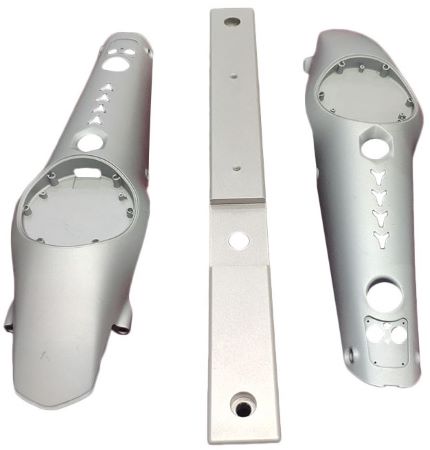
Aerospace compressor blade in Ti-6Al-4VGeometry: 170 mm long, 0.9 mm trailing-edge thickness, 55° twist.Process chosen: 5-axis simultaneous flank milling with 6 mm tapered barrel tool (R3 mm barrel radius).Result: Single-pass finish at Ra 0.4 µm, 65 % cycle-time reduction versus point milling.
Automotive lens mold insert in 1.2343 ESR steel at 52 HRCGeometry: Aspheric surface with 8 mm conformal cooling channels 3 mm below surface.Process: 5-axis circle-segment barrel tool for pre-finish, then ceramic ball for final spark-out.Result: Polishing time dropped from 18 hours to 2 hours per cavity.
Patient-specific cranial plate in Ti-6Al-4V ELIGeometry: 0.8–2.5 mm variable thickness, 42 countersunk holes at compound angles.Process: 5-axis micro-milling with 0.5 mm diamond-coated ball end mill, cryogenic cooling.Result: Zero burrs, surface suitable for osseointegration without secondary blasting.
Use barrel and lens-shaped tools whenever the local radius of curvature exceeds 50 mm.
Apply adaptive clearing (Vera or Volumill style) for roughing pockets deeper than 3×D.
Keep stepover below 4 % of tool diameter on thin walls to limit cutting force variation.
Program tool-axis smoothing (G6.3 or equivalent) to avoid dwell marks on high-curvature transitions.
Implement in-process probing after roughing to update stock model and prevent air cuts.
Matching the right CNC process to a complex geometry and its material is not an art—it is an engineering decision that follows a clear sequence: understand the shape constraints, quantify material removal mechanics, select the minimum capable machine configuration, and verify with full digital twin simulation. When that sequence is followed, cycle times drop, tool life rises, and scrap all but disappears.
The examples and references show the same pattern across industries: 5-axis simultaneous machining, combined with modern tool geometries and constant-engagement strategies, has become the default for any part that cannot be described with simple prismatic features alone. Shops that invest the time upfront to build and trust this selection framework find that the higher hourly rate of advanced machines is more than offset by dramatically lower total cost per part.
Q1: My shop only has 3-axis verticals. Can we still take on impeller jobs profitably?
A: Only if you limit blade count to 7–9 and accept multiple setups plus hand benching. Most customers now expect single-setup 5-axis quality.
Q2: Which coolant works best for 5-axis Inconel finishing?
A: High-pressure through-tool MQL with vegetable-ester oil at 50–70 bar. Flood coolant causes thermal cracking on thin sections.
Q3: How small a feature can a standard 5-axis machine reliably produce?
A: With 0.2 mm micro tools and rigid trunnion machines, repeatable features down to 50 µm are common in production today.
Q4: Is it worth buying barrel tools for mold work?
A: Yes—one 12 mm barrel tool with 750 mm radius can replace five conventional ball-end sizes and cut finishing time by 60–70 % on large gentle curvatures.
Q5: How do I convince management to upgrade to 5-axis?
A: Run a side-by-side quote on a real customer part. The cycle-time and scrap savings usually close the discussion.


